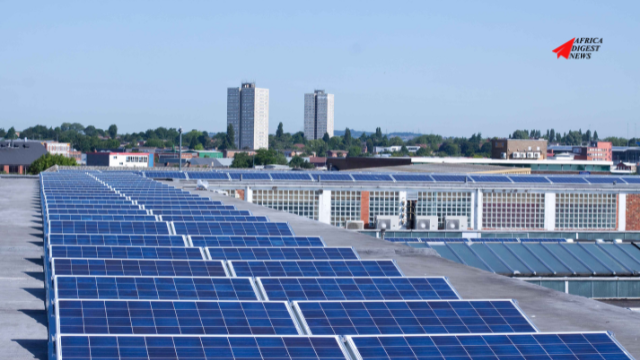
Infinity Power has signed an agreement with solar manufacturer AIKO to supply 773.5 MWp of solar modules for three utility-scale projects in South Africa, bringing a specific technology choice into focus as the projects move through development. The agreement covers AIKO’s All Back Contact (ABC) modules, which use a cell design that places electrical contacts on the rear of the cell rather than across its front surface. The design is intended to improve light capture and conversion efficiency, making module technology an important consideration for large projects where land, installation and balance-of-system costs all affect overall economics.
The appeal of ABC technology lies in how it manages the surface of a solar cell. Conventional modules typically have metal contacts on the front that can shade a small portion of the active cell area. By moving the contacts to the rear, ABC designs reduce that front-side obstruction and can improve the amount of sunlight available for electricity generation. AIKO has developed this architecture as part of its high-efficiency module range, positioning it for projects seeking strong power output from the available panel area.
For a utility-scale developer such as Infinity Power, module efficiency matters because a solar farm is more than the panels themselves. Higher power output per module can affect the number of panels, mounting structures, cables and other components needed to reach a target capacity, although the final benefit depends on module pricing, site conditions, system design and performance over time. Developers must weigh these factors alongside degradation rates, temperature behaviour, reliability, warranties and the cost of maintaining the plant throughout its operating life.
The 773.5 MWp supply agreement also illustrates how procurement choices form part of the transition from a project pipeline to construction. Securing modules gives developers greater clarity over a major equipment requirement, but delivery still depends on financing, engineering, grid access, construction and the arrangements for selling electricity. The contracted capacity represents the combined peak rating of the modules associated with the three projects; it should not be read as 773.5 MW of operating generation already available to South Africa’s electricity system.
Read Also: Why Solar Power Alone Is Not Solving Africa’s Energy Access Problem
South Africa’s need for additional electricity has created opportunities for utility-scale solar, but the commercial performance of each project will depend on more than the technology selected. Efficient modules can contribute to project economics, while financing costs, grid connection, electricity-sale agreements and construction timelines remain decisive. For Infinity Power, the AIKO agreement secures a major component for its planned projects; the next test is how the three developments progress towards construction and commercial operation.


