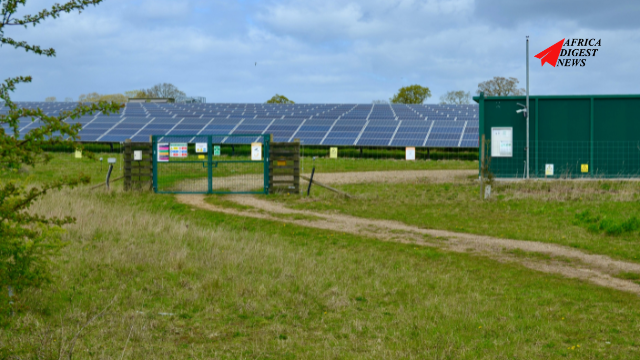
A new community solar facility in Delaware illustrates how shared renewable energy projects are making solar power accessible to households and businesses that cannot install rooftop panels. Located on Fast Landing Road between Cheswold and Leipsic, the project spans approximately 32 acres and features 11,700 solar panels. Developed by TurningPoint Energy and built, owned, and operated by Nautilus Solar Energy, the facility forms part of Delaware’s growing community solar program. Unlike traditional rooftop solar, community solar allows multiple electricity customers to subscribe to a shared solar farm. Instead of installing panels on their own properties, participants receive credits on their electricity bills based on the energy generated by the community project. This model opens access to renewable energy for renters, apartment residents, homeowners with unsuitable roofs, and businesses that lack the space or capital to install their own systems.
The infrastructure visible at the site tells an equally important story. Alongside thousands of photovoltaic panels are power inverters and transformers—critical components that convert the direct current (DC) electricity produced by solar panels into alternating current (AC) used on the electricity grid. Transformers then adjust the voltage so the electricity can be safely transmitted through the distribution network and delivered to customers.
These systems highlight an often-overlooked aspect of renewable energy projects. Solar panels generate electricity, but inverters, transformers, protection systems, and grid interconnection equipment make that electricity usable. As solar deployment increases, investment in these supporting technologies becomes just as important as investment in the panels themselves. Community solar also represents a different approach to expanding renewable energy compared with behind-the-meter installations. Rather than each household investing in its own rooftop system, a single utility-scale facility can serve hundreds or even thousands of subscribers. This creates economies of scale, reduces installation costs per customer, and simplifies system maintenance because the entire facility is professionally operated.
For utilities and regulators, community solar provides another advantage: generation is integrated directly into the electricity network while remaining centrally managed. That makes it easier to monitor performance, maintain equipment, and coordinate electricity flows compared with managing thousands of individually owned rooftop systems.
Read Also: Ireland Loses 15% of Wind Power as Grid Constraints Stall Renewable Energy
The Delaware project reflects a broader trend across the United States, where community solar has become one of the fastest-growing segments of the distributed energy market. As states seek to expand renewable energy access, shared solar programs are increasingly viewed as a practical solution for customers who cannot participate in rooftop solar. The significance of projects like this extends beyond the number of solar panels installed. They demonstrate how renewable energy can be delivered through shared infrastructure, allowing more consumers to benefit from clean electricity without owning generation assets themselves.
As electricity markets continue to evolve, community solar is emerging as an important complement to rooftop solar, utility-scale renewable projects, and other distributed energy models, helping broaden participation in the clean energy transition while making better use of existing grid infrastructure.