South Africa’s energy sector is currently grappling with significant challenges, not least of which is the continuous adjustment of electricity tariffs.
The National Energy Regulator of South Africa (NERSA) recently approved substantial electricity tariff increases, a decision that will have far-reaching implications for both consumers and municipalities. Specifically, Eskom direct customers will face an 8.76% increase, effective from April 1, 2026, while municipalities purchasing electricity from Eskom will see a 9.01% hike, which will be implemented from July 1, 2026.
These staggered implementation timelines reflect the complex regulatory and operational structures governing electricity supply in the country.
The process of setting electricity tariffs in South Africa is governed by the Multi-Year Price Determination (MYPD) framework, a regulatory mechanism designed to provide Eskom with revenue certainty over a multi-year period.
This framework considers several key components, including Eskom’s allowed revenue, its operating costs, necessary infrastructure investments, and a reasonable return on assets. Under the MYPD process, Eskom submits an application to NERSA, detailing its revenue requirements and how these costs will be allocated across different customer segments, such as residential, commercial, and industrial users.
NERSA then conducts a thorough review, often involving public hearings, before making a final decision on the tariff adjustments. This intricate process aims to balance the financial sustainability of Eskom with the affordability of electricity for end-users.
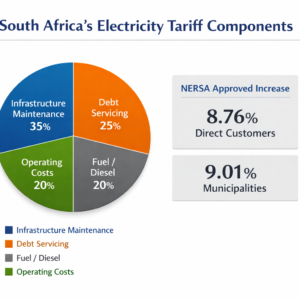
The persistent increase in electricity prices can be attributed to a confluence of factors. A primary driver is the urgent need for infrastructure maintenance and upgrades, particularly for Eskom’s aging power stations, many of which are decades old and prone to breakdowns. The rising costs of fuel, especially diesel used for open-cycle gas turbines (OCGTs) during periods of high demand or generation shortfalls, also contribute significantly to operational expenses.
Furthermore, investments in grid expansion and upgrades are essential to accommodate new generation capacity, including renewable energy sources, and to enhance grid stability. Beyond these operational costs, Eskom’s substantial debt burden, exceeding R400 billion, necessitates revenue generation to service these liabilities. The declining electricity demand from large industries, coupled with rising maintenance requirements, further exacerbates the financial pressure on the utility, leading to upward tariff adjustments.
Read Also: How Long Will 100 ZAR Last in a Small South African Home?
The impact of these tariff increases is widespread, affecting various segments of society and the economy. Households will inevitably face rising electricity bills, placing additional strain on already stretched budgets, particularly for low-income earners. Municipalities, which purchase electricity in bulk from Eskom and then resell it to their residents, often add their own surcharges, potentially leading to even higher costs for consumers.
The industrial sector, including mining and manufacturing, will experience increased energy costs, which could impact their competitiveness and profitability. At a macroeconomic level, rising utility prices contribute to inflationary pressure, potentially dampening economic growth and consumer spending. The challenge for policymakers is to mitigate these adverse effects while ensuring the long-term viability of the electricity supply.
Looking at the long-term trend, South Africa’s electricity tariffs have seen significant increases over the past decade. This trend is a direct consequence of Eskom’s financial instability, the critical need for infrastructure investment, and the country’s slow economic growth. The tariff reforms, while often unpopular, are intended to stabilize the power sector, enable necessary investments, and ultimately ensure a reliable electricity supply for the nation.
Achieving this stability requires a delicate balance between cost recovery, affordability, and the broader socio-economic development goals of South Africa. The ongoing adjustments to the electricity pricing system are a reflection of the complex interplay between economic realities, regulatory mandates, and the imperative to secure the country’s energy future.
By Thuita Gatero, Managing Editor, Africa Digest News. He specializes in conversations around data centers, AI, cloud infrastructure, and energy.