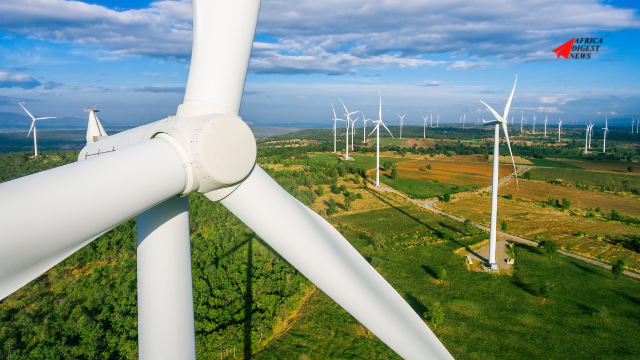
Not every wind turbine is built the same. Some are designed to produce hundreds of megawatts for national electricity grids. Others generate enough electricity to power a remote farm, telecommunications tower or off-grid home.
Despite the differences, almost every wind turbine in operation today belongs to one of two categories:
- Horizontal Axis Wind Turbines (HAWT)
- Vertical Axis Wind Turbines (VAWT)
Understanding these two designs explains why one dominates the global wind industry while the other serves specialised applications.
How Wind Turbines Are Classified
The primary way engineers classify wind turbines is by the orientation of the rotor shaft. If the main shaft runs parallel to the ground, the turbine is classified as a Horizontal Axis Wind Turbine (HAWT).
If the shaft stands vertically, it is known as a Vertical Axis Wind Turbine (VAWT). Although researchers continue developing new concepts, nearly every commercial wind project in the world uses one of these two designs.
1. Horizontal Axis Wind Turbines (HAWT)
When most people picture a wind turbine, this is what they imagine. A tall tower. Three long blades. A nacelle positioned at the top.
The blades rotate around a horizontal shaft while the turbine faces directly into the wind. This design has become the global standard because it converts wind energy into electricity more efficiently than any other commercial turbine currently available.
How They Work
Sensors constantly monitor wind direction. When the wind changes, a yaw system rotates the nacelle so the blades continue facing into the airflow.
As the blades turn, they rotate a shaft connected to a generator, producing electricity. The entire system is engineered to capture as much energy as possible from steady, high-speed winds.
Where They Are Used
Horizontal axis turbines dominate:
- Utility-scale wind farms
- Offshore wind farms
- Large industrial energy projects
- National electricity grids
Virtually every major wind farm in Africa uses this design because it delivers the highest electricity output over its operating life.
Advantages
- Highest electricity generation efficiency
- Proven technology with decades of operating experience
- Suitable for very large turbines
- Lower cost per unit of electricity at utility scale
- Well suited for offshore installations
Limitations
- Must continually face the wind
- Requires tall towers
- Installation costs are higher than small-scale systems
- Maintenance often requires specialised lifting equipment
2. Vertical Axis Wind Turbines (VAWT)
Vertical axis wind turbines look completely different. Instead of spinning like an aircraft propeller, the blades rotate around a vertical shaft. The turbine does not need to turn towards the wind.
It captures airflow regardless of the wind’s direction. This makes the design attractive in locations where wind changes frequently or becomes turbulent around buildings.
How They Work
Because the rotor turns around a vertical shaft, the generator and gearbox can often be positioned near ground level.
That simplifies maintenance compared with large horizontal turbines mounted more than 100 metres above the ground. The trade-off is efficiency.
Current vertical designs generally produce less electricity than comparable horizontal turbines, particularly at utility scale.
Where They Are Used
Vertical axis turbines are commonly found in:
- Small commercial buildings
- Research projects
- Urban installations
- Rooftop applications
- Remote off-grid systems
Their compact design makes them suitable where installing a full-sized horizontal turbine would be impractical.
Advantages
- Operates regardless of wind direction
- Easier maintenance because major components remain closer to the ground
- Performs well in turbulent wind conditions
- Requires less complex yaw mechanisms
Limitations
- Lower electricity production
- Difficult to scale for very large projects
- Limited commercial deployment
- Higher mechanical stresses on the rotating system
Common Types of Vertical Axis Turbines
Vertical axis turbines include several designs, each intended for different operating conditions.
Savonius Turbine
The Savonius turbine uses curved blades that resemble two half-cylinders. It rotates easily in low wind speeds and produces high torque, making it useful for small mechanical applications and limited electricity generation.
Its simplicity comes at the cost of lower efficiency.
Darrieus Turbine
The Darrieus turbine uses curved aerodynamic blades that generate lift rather than relying primarily on drag. It produces higher rotational speeds than the Savonius design but is mechanically more complex and often requires assistance to begin rotating.
Comparison Table
| Feature | Horizontal Axis (HAWT) | Vertical Axis (VAWT) |
| Rotor Orientation | Horizontal | Vertical |
| Must Face Wind | Yes | No |
| Electricity Output | Higher | Lower |
| Commercial Adoption | Very High | Limited |
| Utility-Scale Projects | Excellent | Rare |
| Urban Installations | Limited | Better suited |
| Maintenance Access | More difficult | Easier |
Which Type Is Better?
The answer depends on the project.
For large wind farms supplying electricity to national grids, horizontal axis turbines remain the preferred choice. They generate more electricity, scale efficiently and have decades of proven commercial performance.
Vertical axis turbines serve different objectives. They work well where wind direction changes frequently, available space is limited or maintenance accessibility is a priority.
The two designs should not be viewed as direct competitors. Each solves a different engineering problem.
The Industry Has Already Chosen
The global wind industry has reached a clear conclusion.
Nearly every utility-scale wind project uses horizontal axis turbines because they consistently deliver higher energy output over their operating lives. Vertical axis turbines continue to play an important role in niche applications, research and small-scale installations, but they have not replaced the horizontal design for large electricity projects.
As wind technology continues to evolve, engineers will refine both designs. The underlying objective remains unchanged. Capture more of the wind’s energy.
Generate more electricity. Do it as efficiently and economically as possible.


