Every geothermal project begins with uncertainty. No one knows exactly how much energy lies beneath the surface. No one knows whether the reservoir can sustain commercial production. No one knows whether the economics will justify the investment. The purpose of project development is to eliminate those unknowns, one stage at a time.
This is why geothermal projects take five to seven years to develop and require multiple investment decisions before construction even begins. According to the World Bank’s geothermal development framework, every completed phase reduces geological and financial uncertainty while increasing the level of capital committed. By the time the first turbine starts producing electricity, years of scientific, engineering and commercial decisions have already shaped the project’s outcome.
Stage 1: Preliminary Survey
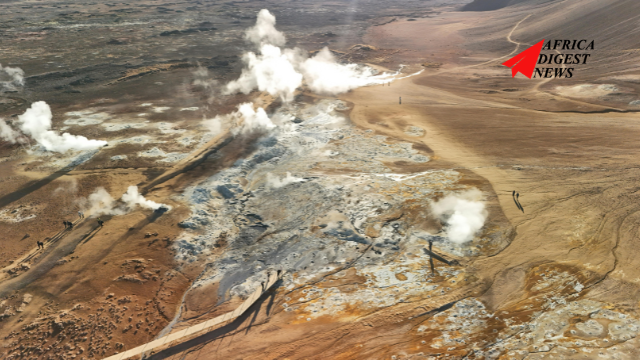
The first investment is information. Developers begin by identifying regions with geothermal potential using geological maps, satellite imagery, volcanic history, fault systems and existing geothermal records. Surface manifestations such as hot springs, fumaroles and altered ground become the first clues that heat is moving toward the surface.
The objective is to eliminate locations where commercial development is unlikely. At this stage, developers also assess transmission infrastructure, land ownership, environmental constraints and electricity demand. A technically viable resource located hundreds of kilometres from the grid may never become an economically viable project.
Stage 2: Resource Exploration
Once a promising area has been identified, exploration becomes more precise. Geologists map fault systems. Geochemists analyse water and gas samples. Geophysicists conduct magnetotelluric, gravity and seismic surveys to image the reservoir beneath the surface.
These datasets are combined into a conceptual reservoir model that estimates temperature, permeability, reservoir size and drilling targets. No drilling takes place blindly. Every exploration activity is designed to improve the probability that the first well will succeed.
Stage 3: Exploratory Drilling
This is where geothermal becomes expensive. Exploration wells are drilled to measure temperature, pressure, permeability and fluid flow directly from the reservoir.
Until this point, every geological model remains an informed prediction. The well either confirms it or disproves it. Exploratory drilling carries the highest geological risk because developers can spend millions of dollars before knowing whether the resource is commercially viable. That early uncertainty is one of the biggest barriers to geothermal investment worldwide.
Stage 4: Feasibility Study and Financial Close
Once drilling confirms the resource, attention shifts from geology to economics. Engineers determine the appropriate power plant technology, estimate generating capacity, design the steam gathering system and calculate drilling requirements for full field development.
Financial analysts evaluate capital costs, operating expenses, electricity tariffs, financing structures, expected cash flows, Internal Rate of Return (IRR) and Levelized Cost of Electricity (LCOE). This is the stage where lenders decide whether the project deserves funding. Heat alone does not attract investment. Bankable economics do.
Stage 5: Field Development
With financing secured, large-scale development begins. Production wells and reinjection wells are drilled across the geothermal field. Steam gathering pipelines, separators, water reinjection systems and field infrastructure are constructed.
This phase determines how efficiently heat moves from the reservoir to the power plant. Poor field development increases operating costs for decades. Well-designed infrastructure improves performance throughout the plant’s lifetime.
Stage 6: Power Plant Construction
Only now does the project resemble what most people imagine. Civil works begin. Foundations are poured. Turbines, generators, cooling systems, transformers and substations are installed before the plant is connected to the national transmission network.
Although highly visible, this is no longer the riskiest stage. By this point, the underground resource has already been proven.
Stage 7: Commissioning and Commercial Operation
Before electricity enters the grid, every system is tested. Engineers verify steam quality, turbine performance, electrical systems, cooling efficiency, reinjection capacity and grid synchronisation.
Only after successful commissioning does the project begin commercial operation. From this point forward, reservoir monitoring becomes a permanent activity. Production rates, reservoir pressure and reinjection performance are continuously analysed to maintain long-term output and protect the resource.
The Development Lifecycle at a Glance
| Stage | Primary Objective |
| Preliminary Survey | Identify commercially promising geothermal prospects |
| Resource Exploration | Build a geological model of the reservoir |
| Exploratory Drilling | Confirm temperature, permeability and commercial viability |
| Feasibility Study | Demonstrate technical and financial viability |
| Field Development | Drill production wells and construct field infrastructure |
| Power Plant Construction | Build generation and transmission facilities |
| Commissioning | Test systems and begin commercial electricity production |