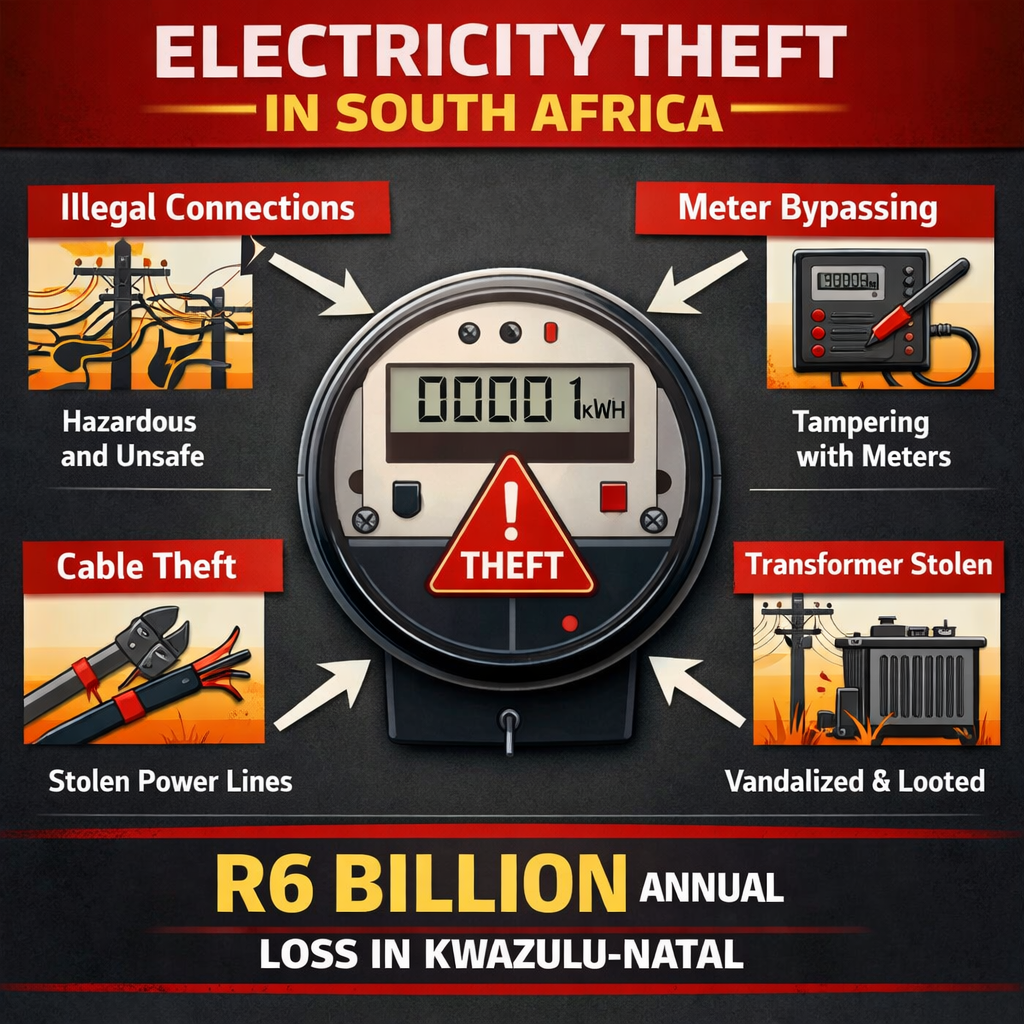
Electricity theft remains a pervasive and costly problem for South Africa’s state-owned power utility, Eskom, significantly undermining its revenue and operational stability. In KwaZulu-Natal (KZN) alone, Eskom estimates that electricity theft costs the utility approximately R6 billion annually.
This staggering figure highlights the scale of the challenge, prompting enforcement operations, such as those recently conducted in Pietermaritzburg, to target illegal connections. These efforts are crucial in a province where a significant portion of Eskom’s 1.2 million customers are reportedly involved in various forms of electricity pilferage, contributing to a national non-technical loss figure that runs into tens of billions of Rands each year.
Electricity theft manifests in various forms, ranging from individual households making illegal connections directly to the grid to more sophisticated schemes involving meter bypassing and the theft of critical infrastructure. Common methods include tampering with electricity meters to under-record consumption, direct connections to power lines that bypass meters entirely, and the theft of cables and transformers.
Alarmingly, stolen equipment, particularly transformers, is sometimes repurposed and reused to facilitate new illegal connections, creating a vicious cycle of theft and infrastructure damage. These illicit activities not only lead to substantial financial losses for Eskom but also pose severe safety risks to communities, often resulting in electrocutions and fires due to unsafe wiring and overloaded systems.
The rise in electricity theft can be attributed to a complex interplay of socio-economic factors. High electricity prices, which have seen continuous increases over the past decade, often push economically vulnerable households to seek alternative, albeit illegal, means of accessing power. The rapid growth of informal settlements, often lacking formal infrastructure and access to basic services, creates fertile ground for illegal connections.
High rates of unemployment and poverty further exacerbate the problem, as individuals and communities struggle to afford legitimate electricity services. Moreover, weak enforcement capacity and perceived impunity can embolden perpetrators. The issue is further complicated by the involvement of organized crime syndicates, particularly in cable theft, which operate sophisticated networks for stealing and reselling valuable copper and other materials, contributing to widespread infrastructure damage and power outages.
READ ALSO: Understanding South Africa’s Electricity Pricing System
The impact of electricity theft on the power system is profound and multifaceted. Financially, it results in billions of Rands in lost revenue for Eskom, directly affecting its ability to maintain infrastructure, invest in new capacity, and provide reliable service. Operationally, illegal connections and cable theft lead to frequent damage to transformers and power lines, causing localized power outages and increasing maintenance costs.
The instability introduced by these illicit activities can also contribute to broader grid instability, making it harder for Eskom to manage supply and demand effectively. Ultimately, the burden of these losses is often passed on to paying customers through higher electricity tariffs, creating a sense of injustice and further incentivizing theft among those who feel unfairly penalized.
Addressing electricity theft represents a significant long-term policy challenge for South Africa and indeed for utilities across many developing economies facing similar issues. Effective solutions require a multi-pronged approach that combines technological innovation, community engagement, and stricter enforcement.
The deployment of smart meters, for instance, can help detect tampering and monitor consumption more accurately. Community partnerships and awareness campaigns, such as Eskom’s “Operation Khanyisa,” can help educate the public about the dangers and consequences of electricity theft and foster a sense of collective responsibility.
Stricter enforcement measures, coupled with infrastructure upgrades to improve grid security, are also vital. Ultimately, addressing this complex issue requires a holistic strategy that tackles the root causes of poverty and inequality while simultaneously strengthening the integrity of the electricity supply system.
The long-term stability and financial health of Eskom, and indeed the broader South African economy, depend on effectively curbing this pervasive problem.
By Thuita Gatero, Managing Editor, Africa Digest News. He specializes in conversations around data centers, AI, cloud infrastructure, and energy.