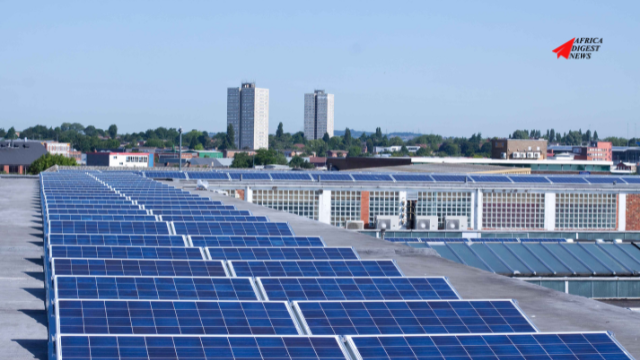
Africa’s solar energy market is significantly larger than previously understood, and its growth is outpacing most of the world, according to the Africa Solar Industry Association (Afsia).
The organization’s Africa Solar Outlook 2026 report estimates the continent now has about 64 gigawatts (GW) of installed solar capacity, almost three times higher than the roughly 23 GW previously recorded in conventional databases.
This recalibration stems from a new methodology that incorporates Chinese export data, revealing that far more solar equipment is entering African markets than official installation figures suggest. As a result, Africa’s share of global solar capacity jumps from 0.7 percent to 2.6 percent, repositioning the continent as a major growth market in the global solar industry.
Afsia highlights that the market expansion has been rapid and sustained. Import-adjusted data shows growth of 122 percent in 2023, 37 percent in 2024, and 17 percent in 2025, making Africa the fastest-growing region globally in 2025, behind only China and the Middle East in absolute growth.
South Africa remains the continent’s solar epicenter. While the post-2022 surge was initially triggered by the country’s persistent power outages, the data indicates that uptake has continued even as grid reliability improved. Falling battery prices, rising electricity tariffs, and increased demand from commercial and industrial users are driving this sustained adoption.
The report emphasizes commercial and industrial solar as a particularly strong growth segment. Mining, manufacturing, retail, and data-heavy industries are increasingly turning to hybrid solar-and-battery systems, which provide power beyond daylight hours and offer cost certainty, lower emissions, and greater energy security.
Read Also: Solar Now Supplies a Tenth of Electricity in Thirteen African Power Systems
One of the most consequential findings is the rapid decline in battery costs, which has reshaped the economics of private power generation across Africa. Lower storage costs make off-grid and hybrid systems more viable, enabling businesses and households to rely less on traditional grid power and more on renewable energy solutions.
Afsia’s findings also underscore the need for updated market data to guide policy and investment decisions. Many analysts believe previous undercounting of solar installations may have led to underestimation of Africa’s renewable energy potential, particularly in decentralized and off-grid solutions.
The report signals a shift from short-term crisis responses to long-term, economically driven adoption. In South Africa, solar expansion has moved beyond coping with load-shedding and into a strategic energy choice for businesses seeking sustainability and resilience. Other countries, including Morocco and Egypt, are also demonstrating strong market growth through supportive policies and investment incentives.
As Africa continues to attract global investment in solar energy, the continent is positioning itself as a key player in the global energy transition. The Afsia report highlights that Africa is not only addressing electricity access and energy security but is also emerging as the world’s fastest-growing market for solar power, setting the stage for a low-carbon future driven by both policy and market demand.
By Thuita Gatero, Managing Editor, Africa Digest News. He specializes in conversations around data centers, AI, cloud infrastructure, and energy.