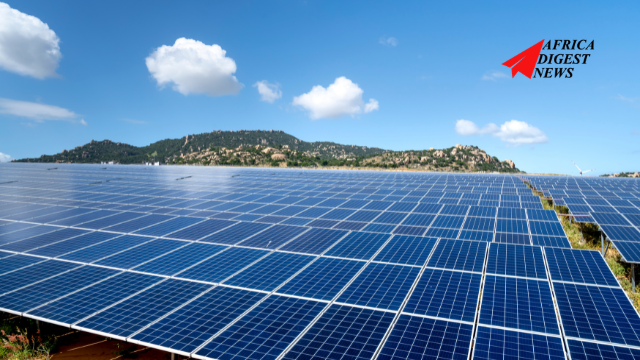
South Africa, Nigeria and Egypt were Africa’s three largest markets for new solar power capacity in 2025, together accounting for a significant share of the continent’s record 4.5 GW of additions. According to Global Solar Council data, South Africa added about 1.6 GW, Nigeria around 803 MW and Egypt roughly 500 MW as solar deployment accelerated across both large-scale projects and distributed systems.
South Africa remained the continent’s biggest solar market, with growth coming from both utility-scale projects and commercial, industrial and rooftop installations. Businesses and households have increasingly turned to solar as a response to unreliable electricity supply and rising grid tariffs, creating a market where solar is not only an investment in new generation but also a way of reducing exposure to grid constraints.
Nigeria’s expansion is being driven by a different set of economics. The country added about 803 MW in 2025, with distributed solar accounting for a large share of the growth. Mini-grids, commercial and industrial systems and home solar are increasingly being deployed as businesses and households seek alternatives to an unreliable grid and the high cost of diesel-powered backup generation.
Read Also: Why Egypt Is Linking Its Wind Boom to a Turbine Manufacturing Industry
Egypt, meanwhile, is combining large-scale solar deployment with an industrial strategy around the technology itself. The country added about 500 MW in 2025 and is also pursuing local manufacturing of solar cells, modules and balance-of-system equipment. That creates a different development model from simply importing equipment and installing projects, with solar increasingly linked to Egypt’s ambitions for domestic industrial capacity.
The three markets are part of a much wider acceleration: Africa’s 4.5 GW of new solar capacity in 2025 represented a 54% increase from the previous year, while the continent’s top 10 markets accounted for about 90% of new additions. The significance of South Africa, Nigeria and Egypt is therefore not just their combined capacity, but the different demand signals they represent—from grid reliability and diesel displacement to utility-scale generation and local manufacturing. Together, they show how Africa’s solar market is expanding through several different economic models at once.


