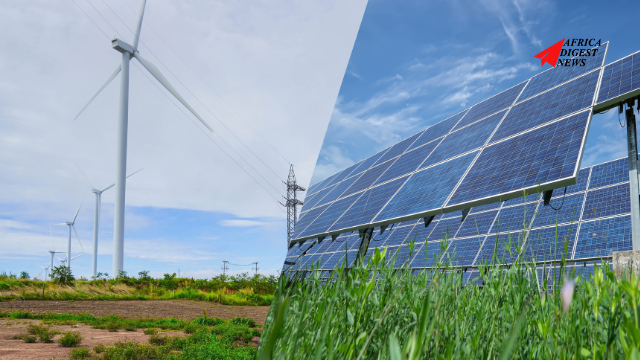
Nelson Mandela University is trying to do something that would have sounded difficult for a South African public institution a few years ago: get about 80% of its electricity from renewable energy. By May 2027, the university expects 50–55% of its demand to come through a 10-year renewable power agreement with Etana Energy, while another 25–30% will come from a new 4.4 MW solar PV platform spread across its seven campuses. The remaining roughly 20% will still come from Eskom. The significance is not that a university is going green. It is that a large electricity user is beginning to manage its power supply as a portfolio rather than simply buying everything from the grid.
The Etana agreement is particularly important because the electricity will be wheeled through the Eskom network to the university’s campuses in Nelson Mandela Bay. Eskom therefore remains part of the system even as its role changes. The university is effectively using the grid as infrastructure while sourcing a large share of its electricity from elsewhere. That distinction is becoming increasingly important in South Africa, where businesses and institutions are finding ways to procure private renewable power without having to build their own entire electricity networks.
Then there is the physical solar capacity on campus. More than 8,500 panels will form the new 4.4 MW installation, building on a 1 MW solar plant that has operated at the Summerstrand South Campus since 2019. The economics are difficult to ignore. NMU currently spends about R60 million a year on electricity and expects the solar system to save roughly R8–10 million annually, while the Etana agreement is expected to deliver another R2–2.5 million in annual savings. The university is therefore not simply paying for decarbonisation. It is trying to reduce its exposure to rising electricity costs.
Reliability is the other half of the calculation. NMU is strengthening its generator infrastructure so that backup power can be managed centrally rather than through separate systems across individual buildings. That matters for a university because electricity is not just a utility expense. Laboratories, research equipment, data systems, teaching facilities and campus operations all depend on it. Cutting emissions by about 12,000 tonnes a year is useful, but avoiding disruption to those activities gives the renewable programme a much more practical justification.
Read Also: What’s Really Driving Africa’s Solar Expansion
The bigger question is whether NMU’s model can spread. A 10-year PPA, wheeling arrangement, onsite solar and centralised backup require capital, contracts and an institution large enough to manage them. But the underlying idea is increasingly difficult to ignore: large electricity users do not necessarily have to wait for the national utility to solve every problem before improving their own power supply. If NMU reaches its 80% target by 2027, the lesson for other universities and public institutions will not simply be that solar works. It will be that power procurement itself is becoming part of institutional strategy.